
How to find your way in the Marrakech medina (and enjoy getting lost)
Par la famille Maison Estran

How to find your way in the Marrakech medina: how the old city is laid out, the landmarks and gates that keep you oriented, why your phone's map gives up under the souks, how to handle unofficial guides, and how to enjoy getting lost on purpose.
Short answer: in the Marrakech medina, steer by a few big landmarks (the Koutoubia minaret, Jemaa el-Fna, the gates in the walls), download an offline map and carry a paper one, expect lanes to end in dead ends, and when you are lost, ask a shopkeeper rather than accept a stranger's offer to walk you. Then relax: everyone gets lost here, and the medina is at its best when you do.
The medina was not designed to be crossed quickly, and it rewards anyone who stops trying. This short guide is for the moments when you would, all the same, like to know where you are.
How the Marrakech medina is laid out
The medina is the old walled city, founded by the Almoravids in the 1070s and listed by UNESCO as a World Heritage Site since 1985 (UNESCO). Its pink walls run all the way round, pierced by gates, the babs. Inside, there are three kinds of street:
- A few main streets, wide enough for cars or at least for scooters and carts, that link the gates to the centre.
- The souks, a dense knot of covered market lanes north of Jemaa el-Fna, each once given to one trade.
- The derbs, the residential lanes that branch off everything else. Many are dead ends that serve a handful of houses and stop at a door. That is where the riads are, and why they are so quiet (we explain the words in Dar or riad?).
The quarters each have their own character, from Mouassine and Dar el Bacha in the north-west to the Kasbah and the Mellah in the south; our neighbourhood guide to the medina walks through them one by one.

The landmarks that keep you oriented
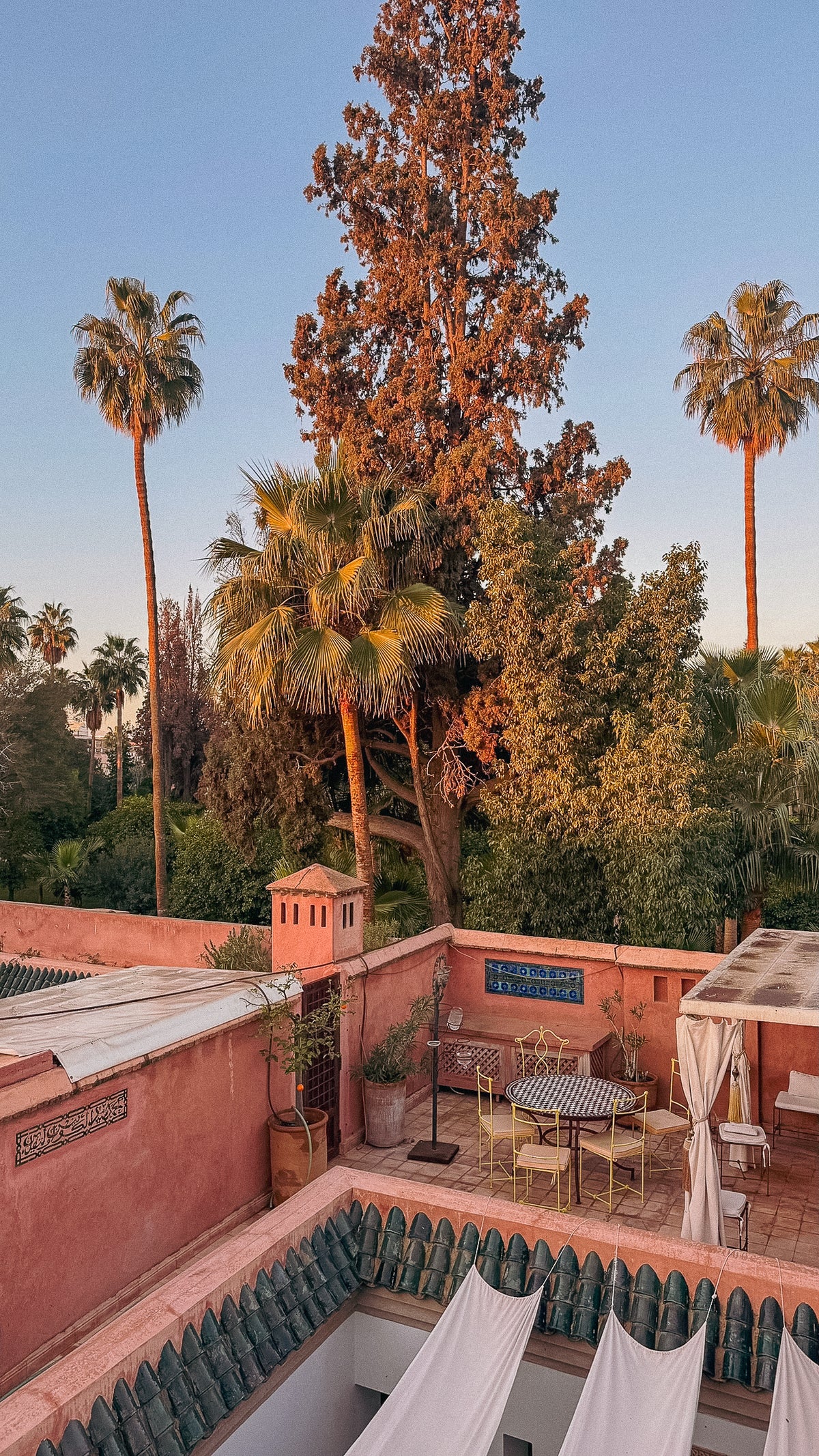
The Koutoubia minaret. The twelfth-century minaret of the great mosque, about 77 metres tall, can be seen from much of the medina and from almost every roof terrace. If you can see it, you know where south-west is, roughly, and where Jemaa el-Fna lies.
Jemaa el-Fna. The great square is the medina's compass point. Nearly every main street leads to it, and if you ask anyone the way to "la place", they will point you there. From the square, Rue Mouassine and the souks open to the north.
The gates. Learn the name of the gate nearest to where you are staying, and you can always ask for it or give it to a taxi. For us, it is Bab Laksour: taxis stop there, and from the gate it is about seven minutes on foot to Dar Estran, with a porter and his handcart taking the luggage.
The flow of people. In the souks, the busiest lanes lead somewhere; empty lanes usually lead to a dead end. When in doubt, follow the crowd.
Does Google Maps work in the Marrakech medina?
Partly. Your phone will find you on the main streets and in the open, and lose you under the roofs of the souks and between high walls, where the signal and the GPS both struggle. Lanes on the map can also turn out to be a locked door, or a passage only a donkey knows about. Lonely Planet's advice is ours too: download an offline map before you set out, and carry a paper one. Pin the gate nearest your riad, not only the riad itself, because the last few lanes are the hardest to map.
Other small habits help. Take a photograph of the corner where you leave the main street, with whatever is distinctive about it: a fountain, a shop sign, a painted door, a tree. Note the time it takes from the gate to your door. And look up: many corners carry a small street plaque with the name of the derb.

Unofficial guides and the "this street is closed" trick
Sooner or later, a friendly young man will tell you that the way ahead is closed, that the tanneries are this way, or that today only there is a Berber market. Most of the time the lane is not closed, and the walk ends in a shop that pays a commission. It is rarely more than a nuisance, and it is easily handled:
- Say no thank you, politely and firmly (la, shukran), and keep walking in the direction you had chosen.
- Do not explain where you are going. "We know the way" is enough, even when it is optimistic.
- If you are lost, ask a shopkeeper sitting in his shop, or an older man, rather than someone who approaches you.
- There are plain-clothes tourist police in the medina and a police station on Jemaa el-Fna.
For a first morning in the souks, the simplest answer is an official guide, booked through your riad, who will show you the trades and the shortcuts and leave you confident enough to go back alone. If you are shopping for something serious, read our rug-buying guide before you go.
Walking in the medina: rhythm, manners and safety
- Keep right and listen. Scooters, donkey carts and handcarts share the lanes. A shout of "balak" means move aside, now.
- Shoes: flat and closed, for uneven paving and the occasional puddle. More in what to wear in Marrakech.
- Fridays at midday: many shops close for the main weekly prayer and the lanes empty for a while. It is a lovely time to walk, and a good time for couscous (see Friday couscous).
- After dark: the main streets stay busy, the derbs become quiet and dim. Carry a small torch or use your phone's, and for a late dinner ask the restaurant or your riad to walk you back.
- Photographs: ask before photographing people, and accept a no with good grace.
- Mosques: in Morocco, mosques in use are closed to non-Muslims; admire them from the street.
Getting lost on purpose: a first walk from Mouassine
If you are staying near us, the north-west of the medina is an easy place to practise. Start at the Mouassine fountain, built in the 1560s beside its mosque, walk south along Rue Mouassine, turn into the souks whenever a lane tempts you, and aim, loosely, for Jemaa el-Fna. When you have had enough, ask for "la place", and from there for Rue Mouassine or the gate of Bab Laksour. Our Dar el Bacha address book has the coffee and lunch stops along the way.
Quick answers
Is it easy to get lost in the Marrakech medina? Yes, and nearly everyone does. Steer by the Koutoubia minaret, Jemaa el-Fna and the gates, and carry an offline map.
Is the Marrakech medina safe to walk at night? The main streets stay busy and are generally fine; the residential lanes become quiet and dark, so take a torch and ask your riad or restaurant to walk you back late at night.
Should I accept help from people offering directions? Decline politely and keep walking; if you need directions, ask a shopkeeper or book an official guide through your riad.
How do I find my riad in the medina? Most riads send someone to meet you at the nearest gate or taxi stop; save that gate in your map, and photograph the last turns on your first walk.
Dar Estran, at the end of a quiet derb in Mouassine, beside the gardens of the royal palace, opens in early 2027. Someone from the house is always on site. Taxis stop at Bab Laksour, and a porter's cart takes the luggage for the last seven minutes on foot; for the whole journey from the airport, read arriving at Dar Estran. For groups who take the whole riad, we are preparing medina tours and shopping with a guide. Join the list on the Dar Estran page to hear first when bookings open.
The Maison Estran Family