
Dar or riad? A small dictionary of the Marrakech house
Por la familia Maison Estran

The difference between a dar and a riad, why our house is called one and is, strictly speaking, the other, and a dozen more words from behind the walls of the medina.
Since we started telling people about our house in Marrakech, one question keeps coming back: what, exactly, is the difference between a dar and a riad? The answer is short. Then it gets a little awkward for us.
The short answer
A riad is a house with a garden in the middle. A dar is a house with a courtyard in the middle. The difference is what grows there.
The Académie française traces riad to the Arabic riyāḍ, the plural of rawḍa: a garden. Strictly, a riad is a house whose central space is mostly garden, classically in four beds divided by two paths that cross at the centre, usually at a fountain, with the beds set a little below the paths. The plan goes back to the Persian chahar bagh, and Marrakech took to it early: the earliest known true riad garden in Morocco was laid out here, in an Almoravid palace of the early twelfth century.
Dar simply means house. Architecturally, a dar is a courtyard house whose centre, the wust ad-dār or "middle of the house", is paved or left unplanted. No garden.
Then there is the sense you will meet on booking sites, where riad now means almost any traditional medina house turned into a guesthouse, garden or not. Even the Académie's definition allows "a courtyard or an interior garden". So if your riad had a paved courtyard and a lemon tree in a pot, you stayed, strictly speaking, in a dar. Nobody will hold it against you.
About our name
The palace that gave our quarter its name does not help. The Dar el Bacha, the house of the pasha, was built in 1910 as the residence of Thami El Glaoui, pasha of Marrakech from 1912, and at its heart is a large riad garden of the textbook kind: four parts, fountains, orange trees. A palace that calls itself a house, around a garden that makes it a riad.
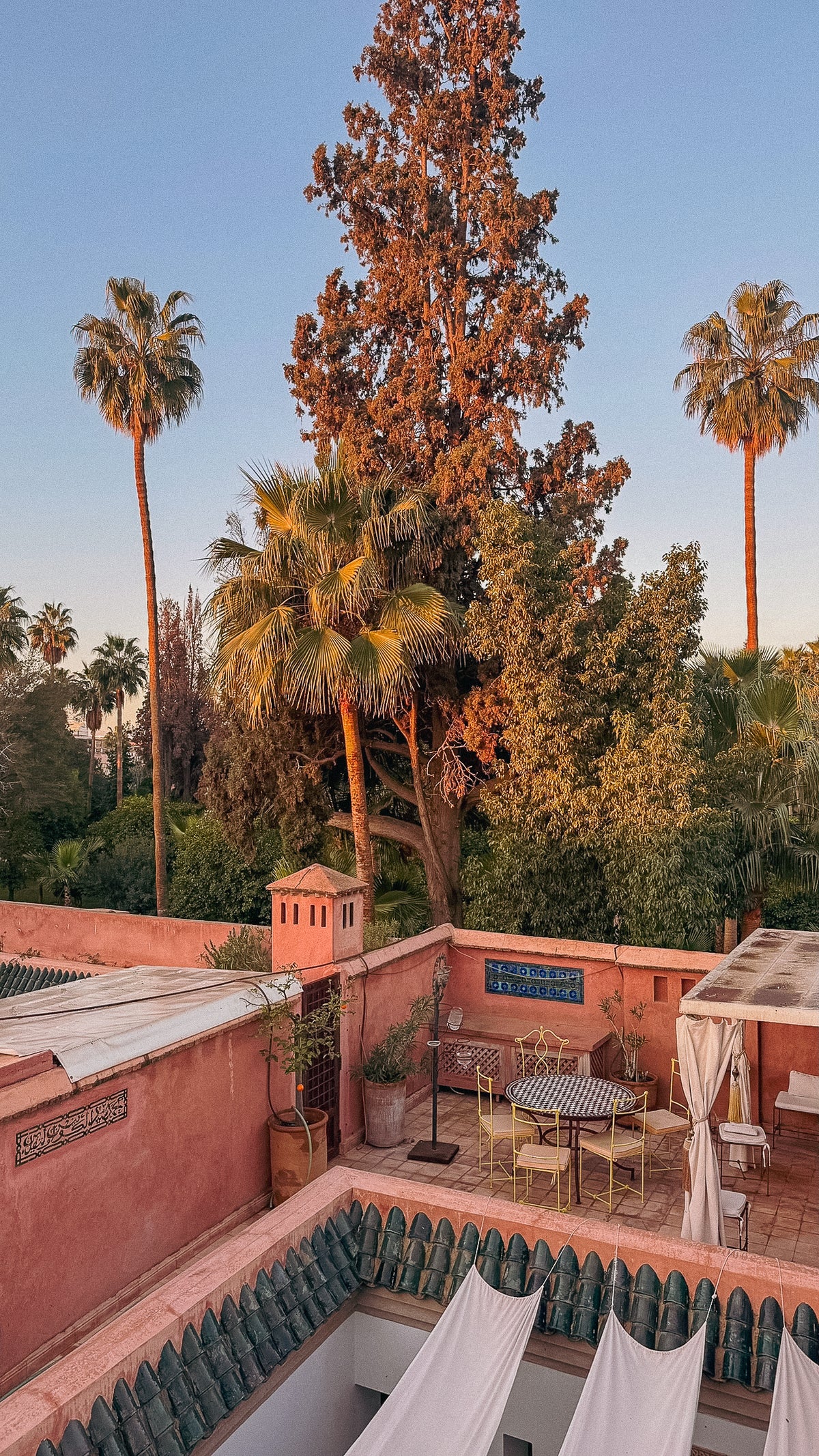
We have done the same. We called ours Dar Estran, the house of Estran, and with its orange trees, its palms and a zellige fountain under an arch, the main patio makes it, strictly speaking, a riad. (A purist would point out that a good part of the middle is swimming pool. We would point at the orange trees and change the subject.) The small patio, paved in brick when we found it, is the honest dar of the pair. One house, then, made of two riads, one of which is a dar, under a name that says house. We have decided this is a feature.
A small dictionary
Roughly in the order you meet them, from the city walls to the roof and back out again.
Medina. The old walled city. French terminologists define it as the part of a town in the Arab world that has kept its traditional structures and housing; the word is the Arabic madīna, a city. The medina of Marrakech was founded by the Almoravids in the early 1070s and has been on the UNESCO World Heritage List since 1985.
Bab. A door, and by extension a gate in the city walls. Some have given their name to a whole quarter: Bab Doukkala, the western gate, to a mosque and to a neighbourhood known for its food market.
Derb. In Darija, Moroccan Arabic, derb means street. In the medina it is usually a narrow residential lane, often a dead end. Ours is. Our door is at the very end, against the gardens of the royal palace, and you hear nothing there but birds.

Dar. A house. To an architect, a house around a paved courtyard. To a palace, a modest way of introducing itself.
Riad. Gardens, in Arabic. A house around a garden. See above, at some length.
Zellige. Small tiles of glazed earthenware, used to make decorative mosaics, particularly in Moroccan Islamic art, in the Académie's words. French borrowed the word in the nineteenth century from the Maghrebi Arabic zelij, glazed terracotta tiles. At Dar Estran it decorates the fountain in the main patio, and for the shower wall of the new bedroom we chose one the colour of bougainvillea. How it is made, and where to watch it being cut, is in our Words & Things on zellige.
Gebs. Carved plaster. The word means gypsum in Arabic; the craft is bas-relief, cut by hand with chisels into thick plaster while it is still damp. At Dar Estran it frames a window in the small patio, the bull's-eye window in the main one and a white scalloped arch in front of a bedroom.
Moucharabieh. In Arabic, mashrabiya: strictly, a projecting window closed with carved wooden lattice, though the word is often used for wooden window screens in general. The usual explanation ties it to the Arabic for drinking, because water jars were set there to cool; a minority prefers a root meaning to look out over. It lets the light in and keeps eyes out. One of our upstairs bedrooms has one, which is why it is among our favourites.
Bejmat. Terracotta tiles, usually rectangular and all of a size, laid on floors. Or, as we explained to the camera in September, "a tile of natural earth". We chose it for the rooftop floor: very natural, very traditional, and it is going to be very pretty.
Douiria. A small house or upper-floor apartment, attached to a larger house and used to receive guests. A Saadian one from the 1560s survives in Mouassine, now a museum. We do not have one, but our small riad can live independently of the big one, which is more or less the same idea.
Hammam. A steam bath. The word is Arabic, glossed by French dictionaries as "hot water". Hammams are traditionally lined with tadelakt, a waterproof lime plaster polished with a flat stone and sealed with black soap. We wondered whether the house needed one. It does: a traditional hammam is going in beside a new massage room, and we are very excited about it.
Funduq. Or fondouk: an urban caravanserai, an inn and warehouse around a courtyard. The word comes from the Greek pandocheion, "welcoming all", and is a cousin of the Italian fondaco. Twenty-six of the medina's fondouks were damaged in the 2023 earthquake; studies to restore them are under way.
Mellah. The Jewish quarter of Moroccan cities. Its origin is uncertain: the Arabic milḥ, salt, a Maghrebi form of maḥalla and a Hebrew word by way of Arabic have all been proposed, so the salt story is one hypothesis among three. Closer to home, the Saadians developed Mouassine, our side of the medina, after Sultan Abdallah al-Ghalib moved the city's Jewish community to a new mellah.
Khettara. An underground gallery that taps the groundwater and carries it by gravity to the surface. The first in Marrakech dates from 1107, under the Almoravids. By the mid-twentieth century more than six hundred had been counted around the city, about five hundred still working, watering some 20,000 hectares. Pumping dried up almost all of them between 1950 and 2000. Worth a thought, next time you sit by a fountain.
Where to see the real thing
For a riad garden as the books draw it, the nearest one open to visitors is the courtyard of the Dar el Bacha, now the Musée des Confluences (Tuesday to Sunday). Why we chose this city at all is in Why Marrakech, why now. If you are going between November and February, our notes on Marrakech in winter will help.
Quick answers
What is the difference between a dar and a riad? A riad is a house built around a garden, classically in four beds around a fountain; a dar is a house built around a paved or unplanted courtyard.
Where does the word riad come from? From the Arabic riyāḍ, the plural of rawḍa, a garden.
Is every "riad" in Marrakech really a riad? No. Guesthouses use the word for almost any traditional medina house, garden or not.
Where can I see a true riad garden? In the courtyard of the Dar el Bacha, now the Musée des Confluences, open Tuesday to Sunday.
Dar Estran opens soon. Call it what you like.
The Maison Estran Family
The house
Dar Estran, Dar el Bacha, Marrakech. Eight bedrooms around two patios, opening early 2027. Be the first to know.